


Modern car seats involve more engineering than their appearance might suggest. Škoda Auto explains how their frames, foam structures and comfort features are developed to provide support and accommodate different occupants.
Each seat starts with a steel frame that acts as the foundation for its other components. Engineers design the frame to accommodate different parts and additional equipment.
Foam components cover the frame, provide the seat’s shape and support the occupant’s body. They must also make room for safety equipment such as airbags and sensors. Beneath the upholstery, seats can incorporate electric adjustment, heating, ventilation and massage functions.
Integrating these features requires careful packaging, often down to the millimetre. Škoda uses pneumatic massage systems in its vehicles. These systems require engineers to consider component placement, adjustment range, noise and vibration levels.
The massage function also relies on software and a dedicated control unit. Engineers must fine-tune airflow through the cushions, inflation timing, inflation sequence and massage intensity. Although occupants can activate the function with a button, its development involves both hardware and software work.
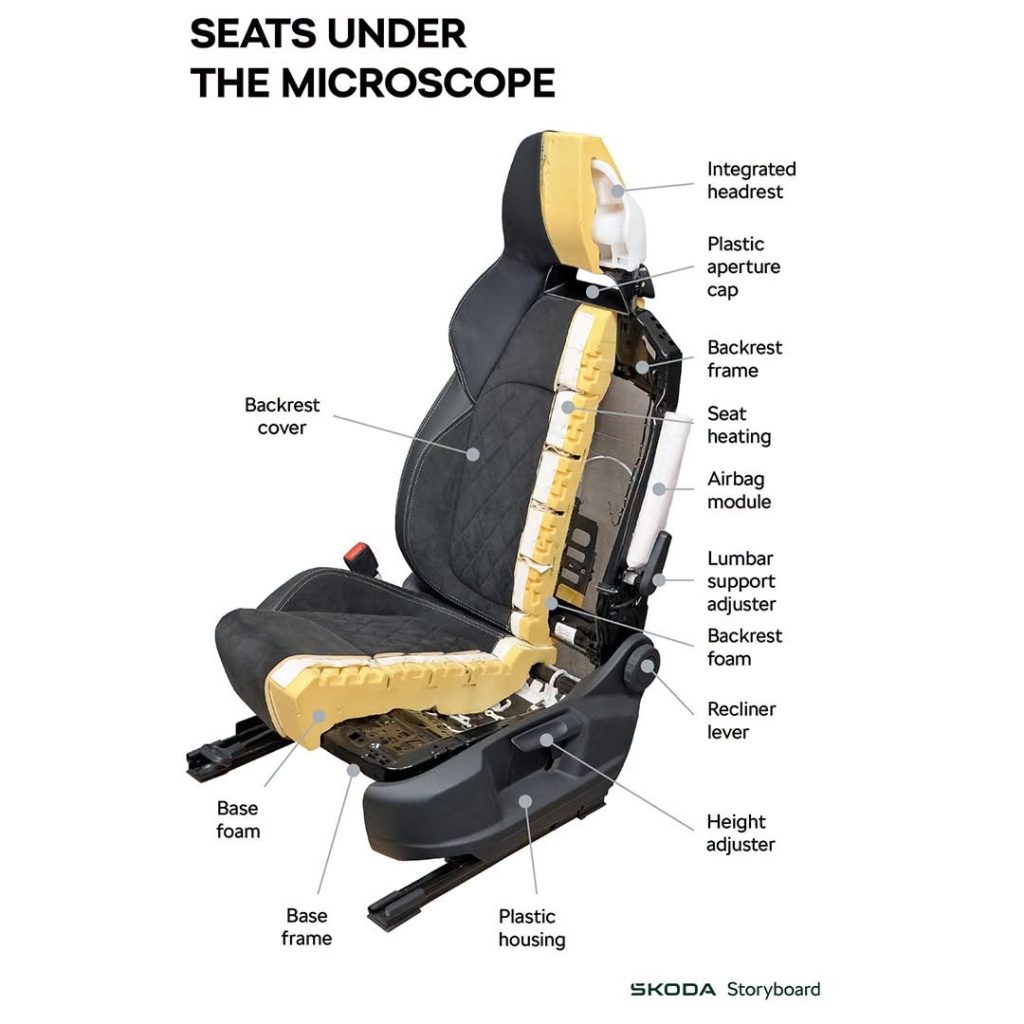
Ventilated seats require additional hardware and air channels integrated into the foam. Heated seats also need temperature sensors to prevent occupants from getting injured. These components leave less room for the foam structure, making the available space a key part of seat development.
Škoda’s engineers define several basic comfort measurements during development. These include cushion width and length, side bolster height, backrest width and height, and the overall seat height. Engineers also consider the head restraint’s contact area.
The company evaluates these measurements through release validation drives. A broader sample of people provides feedback to help refine the seats before production.
Seats must accommodate occupants with different body sizes and builds. Cushion length is particularly important for proper support. A cushion that is too long can press against the area beneath the knees and affect blood circulation. A cushion that is too short may provide insufficient thigh support and place additional strain on the pelvis.
Some Škoda models therefore offer adjustable cushion lengths to help occupants find a suitable seating position.
Testing begins with the earliest design proposals and continues until the vehicle receives final homologation. Seats undergo structural tests to assess rigidity and durability. Engineers also evaluate restraint systems, including airbags and their anchorage points.
The company conducts seasonal testing for comfort features as well. Summer tests assess ventilation performance, while winter tests evaluate seat heating.
These processes ensure that modern car seats meet structural, safety and comfort requirements before reaching customers.