Hanyang University Study Identifies Hidden Battery Flaw Affecting EV Lifespan
Researchers discover simple manufacturing adjustment that improves durability of next-generation EV batteries

Researchers from Hanyang University ERICA have identified a previously overlooked flaw in next-generation high-nickel EV batteries that could significantly reduce battery lifespan, while also proposing a simple manufacturing solution to improve long-term durability.
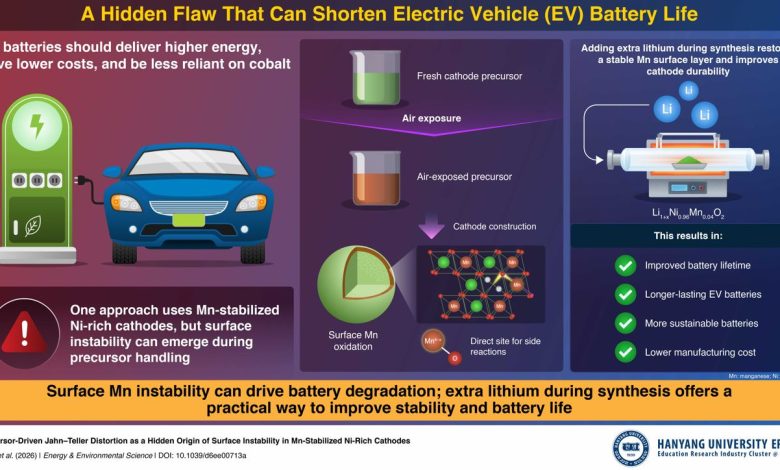
The study focuses on cobalt-free, manganese-coated high-nickel cathodes, which are increasingly being developed as a more sustainable and cost-effective alternative for electric vehicles. While these batteries offer higher energy density and reduced reliance on expensive critical minerals, the research found that exposing precursor materials to air during manufacturing can trigger chemical changes that accelerate battery degradation.
According to the research team led by Professor Jin Ho Bang and PhD scholar JinHa Shim, air exposure causes manganese on the surface of the battery material to oxidize, creating highly reactive defects that promote electrolyte decomposition, transition-metal dissolution, and unwanted reactions with the battery’s graphite anode. These hidden defects can nearly double the rate of capacity loss during long-term battery cycling.
The researchers also discovered a practical solution to the issue. By increasing the amount of excess lithium during the cathode synthesis process, they successfully suppressed the formation of the defective surface structure and restored stable manganese-oxygen bonding. Batteries produced using this approach retained more than 90% of their capacity during testing, demonstrating significantly improved long-term performance.
The findings highlight that careful management of precursor materials is just as important as reducing cobalt content in the development of next-generation EV batteries. Rather than requiring expensive redesigns or additional protective coatings, manufacturers could improve battery durability through better precursor handling and optimized lithium content during production.
Published in the journal Energy and Environmental Science, the study provides valuable insights for battery manufacturers as the industry continues to develop longer-lasting, high-energy batteries for electric vehicles and large-scale renewable energy storage systems.