
Car prices in Malaysia were considerably lower before the national car project began in the 1980s. In 1980, a Datsun 120Y cost RM13,579, while a Toyota Corolla DX was priced at RM14,152. A Honda Civic was even cheaper at RM12,950.
European models were also more affordable than many might expect. The Volvo 244, popular among senior civil servants and doctors, cost less than RM40,000.
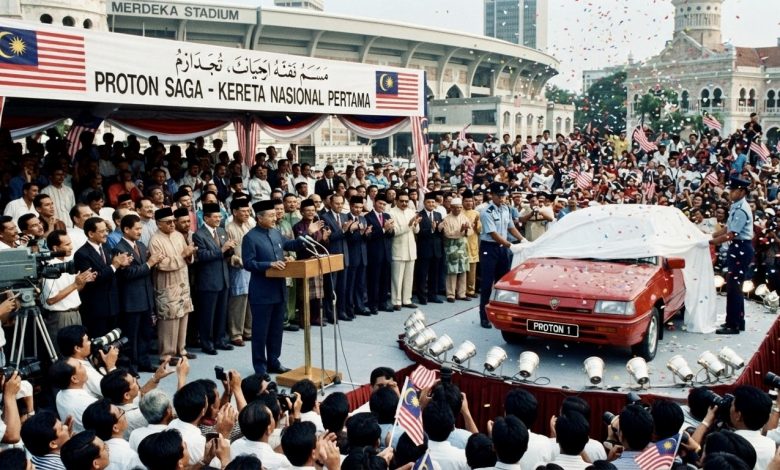
However, the market began changing following the establishment of Perusahaan Otomobil Nasional (Proton) in May 1983. Its first model, the Proton Saga, was launched in July 1985 at RM17,575 for the 1.3S variant.
The launch formed part of Malaysia’s national industrialisation strategy. However, policies introduced to protect the new manufacturer also changed the pricing structure for competing brands.
Before Proton: A competitive assembly market
Before 1985, Malaysia had a relatively open automotive assembly industry. Since the late 1960s, the government had encouraged foreign manufacturers to establish local Completely Knocked-Down (CKD) assembly operations.
Japanese brands such as Datsun, Toyota, Honda and Mazda operated alongside European manufacturers.
Import duties during this period reportedly ranged from 30% to 80% for completely built-up (CBU) vehicles. CKD kits faced lower duties of approximately 20% to 30%.
Without a dominant national manufacturer, local assemblers competed under a more similar tax structure. Competition among Japanese and European brands helped keep prices relatively competitive.
Tariff increases following the National Car Project
The National Car Project faced a major challenge: achieving sufficient production volume. Malaysia’s passenger car market in the mid-1980s was estimated at around 90,000 units annually.
This was below the estimated 200,000-unit threshold needed for a standalone manufacturer to achieve competitive economies of scale.
To help Proton establish itself, the government introduced protectionist measures aimed at increasing domestic market share.
Import duties on CBU vehicles reportedly increased to between 80% and 150%. For larger engine capacities, duties later reached as high as 300%.
CKD kits and imported components used by non-national car assemblers also faced higher duties. These reportedly increased to between 40% and 60%.
The increases particularly affected vehicles with engines between 1,200cc and 1,600cc. This was the same segment occupied by the Proton Saga’s 1.3-litre and 1.5-litre variants.
Different tax treatment for Proton
Proton received exemptions from CKD kit import duties and major excise and sales taxes. Competing assemblers, meanwhile, had to absorb higher import duties alongside applicable excise duties and sales taxes.
Research by Australian National University economist Prema-chandra Athukorala described how this difference created an estimated 10% to 20% pricing advantage for Proton.
Other manufacturers consequently faced higher costs when competing in the same market segments. Japanese models in particular could no longer maintain their previous price positioning without absorbing the additional costs.
These policies helped protect Proton during its early development. However, they also contributed to a more expensive market for competing brands, establishing a tax structure that continued to influence Malaysian car prices in subsequent decades.