
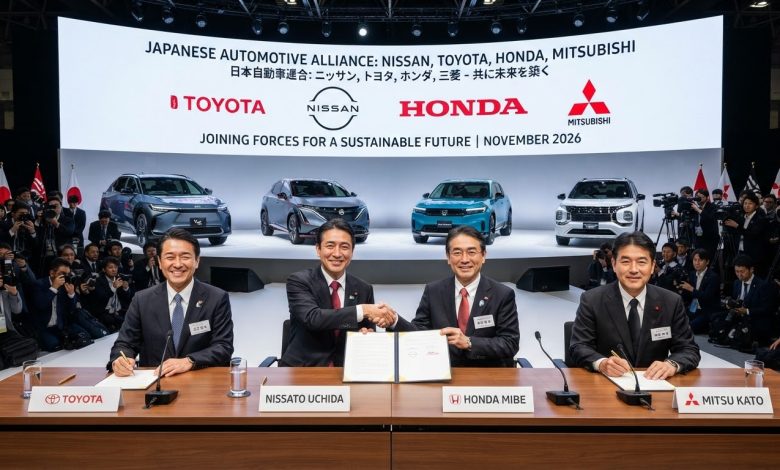
Four major Japanese automakers are expanding cooperation across vehicle components, manufacturing, vehicle platforms and software development.
Toyota, Honda, Nissan and Mitsubishi are pursuing different partnerships rather than forming a single joint venture. The initiatives aim to reduce development costs, improve supplier efficiency and strengthen their position in international markets.
The cooperation comes as Japanese manufacturers face growing competition from Chinese automakers. Companies such as BYD and Geely have accelerated electric vehicle development and expanded their software capabilities.
Japan’s ageing workforce and rising production costs have also placed pressure on domestic suppliers. Standardising components could reduce manufacturing complexity and improve efficiency across the industry.
Japanese automakers standardise vehicle components
On November 19, 2026, the Japan Automobile Manufacturers Association (JAMA) resolved to standardise selected vehicle components alongside the Japan Auto Parts Industries Association (JAPIA).
JAMA includes 14 automakers and is chaired by Toyota President Koji Sato. Its members include Toyota, Honda, Nissan and Mitsubishi.
The standardisation initiative covers steel grades, resin grades and wire harnesses. It also includes common evaluation standards for recycled plastics.
Japanese suppliers currently manage approximately 70,000 wire harness variations. Reducing these differences could improve production efficiency and simplify supplier operations.
The initiative aims to free up resources for other development areas, including electrification and autonomous driving. Standardising components that do not directly affect vehicle appearance or driving characteristics also allows manufacturers to retain their individual product identities.
Thailand receives investment commitments
The four automakers are also involved in a wider Japanese automotive investment initiative in Thailand.
During a Thailand Board of Investment roadshow in Tokyo from November 17 to 20, Toyota, Honda, Nissan and Mitsubishi joined Isuzu and Mazda in confirming combined investment commitments exceeding THB134 billion (approximately RM16.4 billion).
The investment covers the 2026–2030 period. The companies plan to strengthen Thailand’s automotive production ecosystem, including manufacturing for hybrid vehicles, battery electric vehicles and other electrified powertrains.
The initiative also covers automation and local parts manufacturing. It is intended to maintain Thailand’s position as an important production and export base for Japanese automakers.
The cooperation also links with a Thailand–Japan semiconductor strategic partnership. This initiative covers power semiconductors and sensors used in automotive applications.
Honda, Nissan and Mitsubishi expand vehicle sharing
Beyond industry-wide initiatives, Honda, Nissan and Mitsubishi are continuing their trilateral cooperation.
The partnership builds on a strategic memorandum of understanding signed in 2024. One example is the Mitsubishi Triton-based Nissan Navara, which uses Mitsubishi’s pickup platform.
Honda and Mitsubishi also signed an agreement on October 22, 2026, to develop a Honda pickup based on the Triton’s ladder-frame platform.
The new model is scheduled to reach ASEAN markets in 2028. The arrangement would allow Honda to enter the regional pickup segment while using Mitsubishi’s existing platform and manufacturing capabilities in Thailand.
Joint development of vehicle software
Honda and Nissan are also working together on software-defined vehicle technology.
The companies signed a binding agreement on August 31, 2026, covering the development of electronic control units, zonal architectures, middleware and an in-vehicle operating system.
Mitsubishi is evaluating whether to participate in the initiative. Vehicles using the jointly developed software architecture are expected from fiscal 2029.
Toyota is pursuing related standardisation work through broader initiatives involving Japan’s Ministry of Economy, Trade and Industry. This includes efforts to standardise vehicle body-control software specifications.
A wider approach to competition
These partnerships cover different parts of vehicle development and manufacturing. They allow the companies to share costs and resources without merging their brands or entire operations.
For Japanese automakers, the approach provides a way to address changing technology requirements and production costs. It also supports their existing manufacturing presence in Southeast Asia.
The initiatives show how the companies are pursuing cooperation in selected areas while continuing to compete in the global vehicle market.